Who Was William Heseltine?
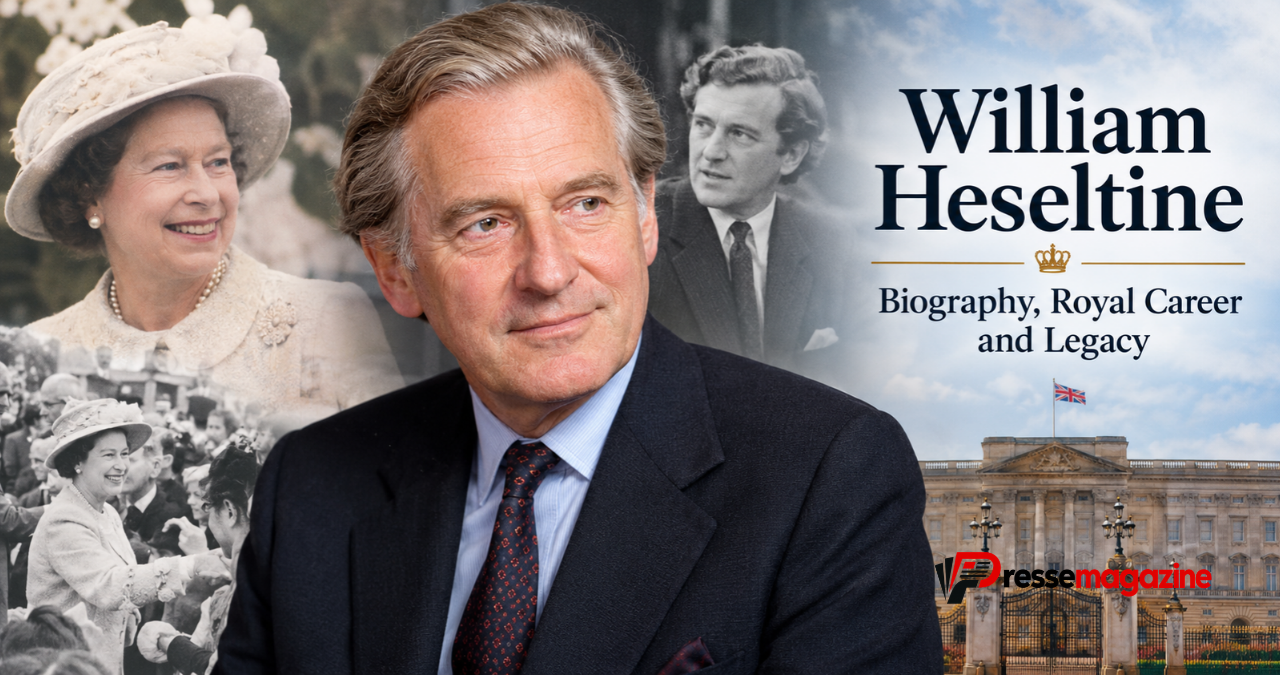
William Heseltine was an Australian public servant and senior royal courtier who became one of the most important advisers to Queen Elizabeth II. Born in Western Australia in 1930, he developed a distinguished career in government before joining the Royal Household. He eventually became Queen Elizabeth II’s Private Secretary, serving from 1986 to 1990. During his 27 years connected with Buckingham Palace, William Heseltine became recognised for helping modernise the monarchy’s relationship with the press and the public. His influence was particularly important because he understood that the Royal Family needed to adapt to a rapidly changing media landscape.
William Heseltine was different from many traditional royal courtiers because he was not born into the British aristocracy. He came from Western Australia and built his reputation through education, government service and political administration. His practical understanding of communications eventually made him a valuable figure within the Palace. His career included work as an assistant press secretary, press secretary, assistant private secretary and deputy private secretary before he reached the senior position of Private Secretary. This progression gave him an unusually broad understanding of the monarchy from both inside and outside the royal establishment.
William Heseltine Early Life and Education
William Frederick Payne Heseltine was born on 17 July 1930 in Western Australia. His early years were shaped by a family with strong connections to education, as both of his parents were teachers. Part of his childhood was spent in Wyalkatchem, a small Western Australian community, before he attended Christ Church Grammar School in Claremont. He later studied history at the University of Western Australia, where he achieved first-class honours. His academic background gave him a strong foundation for the administrative and political career that followed.
After completing university, Heseltine joined Australia’s Prime Minister’s Department in 1951. His career developed quickly, and by the age of 25 he had become private secretary to Prime Minister Sir Robert Menzies. He later served in other government and political positions before his work brought him into contact with the British monarchy. These experiences were important because they taught him how governments operated and how senior public figures dealt with difficult political and media situations. Those skills would later become central to his work at Buckingham Palace.
William Heseltine and Buckingham Palace
Heseltine’s connection with Queen Elizabeth II began in the early 1960s when he worked temporarily as an assistant press secretary. After returning to Australia for a period, he was eventually brought back to London and joined the Royal Household permanently. He became assistant press secretary before being promoted to press secretary in 1968. In 1972, he moved into the Private Secretary’s Office, beginning a new stage in a career that would ultimately lead him to the most senior advisory position under the monarch.
His arrival at the Palace came during a period when royal communications were beginning to change. The traditional approach had often involved keeping journalists at a considerable distance, but Heseltine believed the monarchy could not remain disconnected from a modern public. He recognised that newspapers, television and changing social attitudes were reshaping the way institutions were understood. Instead of treating the media solely as a threat, he saw communication as something the Royal Family could use carefully to explain its work and maintain public interest.
William Heseltine and the Royal Family Documentary
One of William Heseltine’s most notable contributions was his involvement in the groundbreaking 1969 BBC documentary Royal Family. The programme offered viewers an unprecedented glimpse into the private and working life of Queen Elizabeth II and her family. It showed scenes that would previously have been considered unusually personal, including family activities and informal moments. The documentary attracted a huge audience and became an important moment in the history of royal broadcasting, although it was later withdrawn from regular public circulation.
The documentary reflected Heseltine’s belief that the monarchy needed to communicate with the public rather than simply expect public loyalty. He understood that television could make the Royal Family appear more familiar while also creating risks if too much access was granted. That balance became a recurring theme throughout his career. His approach helped establish a more open style of royal communication, and many of the principles he supported continued to influence how the monarchy interacted with journalists and the public in later decades.
William Heseltine and the Royal Walkabout
William Heseltine was also closely associated with the development of the royal walkabout, an approach that changed how members of the Royal Family interacted with ordinary people during official engagements. Rather than always remaining behind formal barriers, royals could meet members of the public more directly and create spontaneous moments of conversation. The approach became particularly associated with the Queen’s 1970 tour of Australia and eventually became a familiar part of royal visits around the world.
The significance of the walkabout went beyond simple public relations. It allowed the monarchy to demonstrate accessibility while maintaining the dignity associated with royal duties. Heseltine understood that people were increasingly interested in seeing the human side of public institutions. By encouraging more direct encounters, he helped create a style of royal engagement that later became almost expected. Today, photographs and short conversations between members of the Royal Family and the public are normal features of official visits, making Heseltine’s influence particularly enduring.
William Heseltine as Queen Elizabeth II’s Private Secretary
William Heseltine became Queen Elizabeth II’s Private Secretary in April 1986, succeeding Sir Philip Moore. He remained in the position until October 1990 and became the first Australian to hold this highly influential role. The Private Secretary served as a central link between the monarch, government and wider public institutions, while also helping manage the Queen’s official programme and providing constitutional and political advice. Heseltine therefore stood at the centre of some of the most important royal and national matters of the period.
His time as Private Secretary included politically sensitive years, particularly during Margaret Thatcher’s premiership. Heseltine later discussed the difficult relationship between Downing Street and Buckingham Palace and rejected claims that Queen Elizabeth II had personally authorised certain media stories about the Prime Minister. His recollections offered an insider’s perspective on the careful separation between the Queen’s constitutional role and political disagreements surrounding the government. He consistently presented the monarch as disciplined, calm and committed to her responsibilities.
William Heseltine and Queen Elizabeth II
The professional relationship between William Heseltine and Queen Elizabeth II developed into one of considerable trust. Heseltine later spoke warmly about the late Queen, describing her as calm, intelligent and highly committed to her responsibilities. He also remembered her as a supportive employer who valued loyalty among her staff. Reports have suggested that she affectionately referred to him as “my Bill”, reflecting the personal familiarity that developed during their many years of working together. Their association continued after his retirement through correspondence.
Heseltine remained connected with Queen Elizabeth II long after leaving the Royal Household. In interviews following her death in 2022, he recalled their working relationship with evident admiration. He described conversations with her as uplifting and praised her ability to remain composed under pressure. These comments provided a personal insight into the monarch that differed from the more formal image usually presented to the public. His memories also demonstrated how deeply professional loyalty could develop during decades of service within the Royal Household.
William Heseltine’s Honours and Achievements
William Heseltine received numerous honours during his career, reflecting his long service to both the Crown and public life. His distinctions included senior British royal and national honours, as well as recognition from Australia and other Commonwealth countries. He was appointed a Companion of the Order of Australia in 1988 and became a Privy Counsellor. His honours demonstrated the importance of his contribution to the Royal Household and recognised the unusual distinction of an Australian reaching such a senior position within the British monarchy.
His achievements were not limited to holding an important royal title. Heseltine helped change the way Buckingham Palace communicated with journalists, television audiences and ordinary members of the public. His work on Royal Family and the development of royal walkabouts demonstrated his willingness to experiment with communication while respecting the institution’s traditions. His philosophy was essentially one of careful modernisation. He believed the monarchy should not become excessively avant-garde, but he also recognised that it could not afford to fall too far behind changing public expectations.
William Heseltine After Leaving the Royal Household
After retiring from royal service in 1990, William Heseltine returned to Western Australia and entered the corporate world. He became a company director and held a number of business positions, including senior roles connected with NZI Insurance Australia and other organisations. His life after Buckingham Palace was considerably quieter, but his experience remained highly respected. Although he had stepped away from the centre of royal life, his career continued to reflect the administrative and leadership skills that had defined his years in government and royal service.
Heseltine maintained a strong interest in public affairs and continued to speak about his experiences when appropriate. His later interviews became valuable sources for understanding Queen Elizabeth II and the internal workings of the Royal Household. He also remained interested in Australia’s relationship with the monarchy, an issue that had been part of his professional life for decades. His retirement therefore did not completely sever his connection with the world of public service, even though he largely avoided the intense attention that came with his former position.
William Heseltine Family and Personal Life
William Heseltine’s personal life was considerably more private than his professional career. He was married three times and had children, while his later years were spent largely away from the public spotlight in Western Australia. His first wife, Ann, died in a car accident in 1957, and his second wife, Audrey, died in 2013. His third wife was Diana, Lady Heseltine. His family life remained mostly separate from his public responsibilities, reflecting the discreet character he maintained throughout much of his career.
Despite spending decades around one of the world’s most famous families, Heseltine rarely sought personal attention. His professional philosophy centred on supporting the monarch rather than becoming a public personality himself. This discretion was particularly valuable in a role where sensitive information, political discussions and private conversations could have significant consequences. His reputation was therefore built largely on judgement, loyalty and communication skills rather than celebrity. That understated approach helps explain why his influence was substantial even though his name remained unfamiliar to many members of the public.
William Heseltine Death in 2026
Sir William Heseltine died on 2 October 2026 at the age of 96. His death marked the end of an extraordinary life that connected Western Australia with Buckingham Palace and placed him at the heart of Queen Elizabeth II’s reign. Reports following his death highlighted his contribution to modernising the Royal Family’s relationship with the media and public. He was remembered as a significant royal courtier whose influence could be seen in the more open style of royal communication that developed during the Queen’s long reign.
The news of his death also brought renewed attention to the important role played by private secretaries and other senior royal advisers. These figures rarely receive the same public recognition as monarchs, yet they can influence how royal institutions respond to political, social and media pressures. Heseltine’s career illustrates this clearly. From his Australian government beginnings to his years alongside Queen Elizabeth II, he helped navigate a monarchy moving from traditional forms of communication towards a more modern relationship with the public.
William Heseltine’s Lasting Legacy
William Heseltine’s lasting legacy is closely connected to modern royal communication. He recognised that an institution as old as the monarchy could not simply rely on tradition to maintain public confidence. His involvement in Royal Family, his encouragement of direct public contact and his senior advisory work all reflected a willingness to adapt. He understood that modernisation needed to be controlled rather than dramatic, allowing the monarchy to evolve without losing its sense of continuity or dignity.
His career also remains notable because he successfully crossed national and institutional boundaries. An Australian who began his career in Canberra eventually became one of Queen Elizabeth II’s closest senior advisers in London. His story demonstrates how professional ability could overcome the traditional barriers of Britain’s royal establishment. William Heseltine may not have been a household name, but his influence reached millions through the changing public image of the Royal Family. For that reason, his contribution remains an important chapter in the modern history of the British monarchy.
Conclusion
William Heseltine’s life was remarkable because his influence was often exercised quietly from behind the scenes. From his beginnings in Western Australia to his rise through the Royal Household, he became an important figure in the transformation of Queen Elizabeth II’s public image. His work helped the monarchy respond to television, changing journalism and rising expectations for greater public access. His contribution to Royal Family, royal walkabouts and Palace communications demonstrated a belief that tradition could survive only by adapting thoughtfully to a changing society.
His death in October 2026 closed a remarkable chapter in the history of the British monarchy. William Heseltine served Queen Elizabeth II during some of the most significant decades of her reign and remained respectful of the institution long after retiring. His story offers a valuable reminder that major changes within historic institutions are often shaped by advisers whose names remain outside the headlines. For anyone researching William Heseltine, his legacy is ultimately one of service, discretion, modernisation and lasting influence on the way the Royal Family connected with the public.
FAQs
Who was William Heseltine?
William Heseltine was an Australian public servant and royal courtier who worked for Queen Elizabeth II for 27 years. He eventually became her Private Secretary from 1986 until 1990. He was particularly influential in modernising the Royal Household’s approach to the press and public engagement.
When was William Heseltine Queen Elizabeth II’s Private Secretary?
William Heseltine served as Queen Elizabeth II’s Private Secretary from April 1986 until October 1990. He succeeded Sir Philip Moore and was followed by Sir Robert Fellowes. Heseltine was the first Australian to hold the prestigious position during Queen Elizabeth II’s reign.
What was William Heseltine famous for?
William Heseltine was best known for helping modernise royal communication. He was involved in the 1969 BBC documentary Royal Family and was associated with the development of the royal walkabout. His approach encouraged the monarchy to become more open and accessible to the public.
Was William Heseltine Australian?
Yes. William Heseltine was born in Western Australia and built the early part of his career in Australian government and politics. His Australian background made his appointment as Queen Elizabeth II’s Private Secretary particularly distinctive, as he became the only Australian to hold that position.
When did William Heseltine die?
Sir William Heseltine died on 2 October 2026 at the age of 96. He had retired from Buckingham Palace in 1990 and later lived in Western Australia. His death was widely reported as the passing of an important modernising figure from Queen Elizabeth II’s reign.
You may also read
august hanning